
Monkeys and Sloths: Photographing Costa Rica’s Canopy
Canopy wildlife photography in Costa Rica encourages you to look upward and slow down. Monkeys and sloths may be partly hidden by branches, far above the trail or visible against a bright sky. Those conditions can become part of the image instead of an obstacle to remove: height, layers and small glimpses help describe life in the trees.
Costa Rica Tourism Board: The tourism board describes encounters with monkeys and sloths among Costa Rica’s wildlife experiences.
Work with the view you have
First find a stable, permitted place to observe. Look for openings between leaves, but do not leave the trail or stand beneath an animal simply to increase its size in the frame. A guide can help interpret an encounter and distinguish species. Photograph a clear view when it appears, then allow yourself a looser image that includes the branches supporting the animal.
Notice how light changes the story
A bright sky behind dark fur can be challenging. Review your exposure and decide whether you want detail in the animal or a deliberate silhouette. A patch of softer light can reveal texture without making the whole canopy equally bright. Avoid rushing from one position to another: an animal may turn naturally, while your own movements can affect its behavior or distract other visitors.
Combine wildlife and forest photographs
Investigate the Arenal area, Sarapiquí and Osa for appropriate wildlife activities, while remembering that an advertised region does not guarantee a specific animal. Use intervals between encounters for forest layers, leaves or wider habitat scenes. Some animals remain still; others move rapidly. Let the actual encounter decide whether a portrait, an action image or a contextual photograph is the sensible priority.
Recommendations for your visit
- Ask the guide to explain what is happening before assigning a story to the photograph.
- Keep enough space around the subject for an upward-looking composition.
- Do not feed, touch or move wildlife to improve the view.
Connect the subject with your route
Compare Arenal and La Fortuna, Osa Peninsula. Check current access, services and conditions directly before finalizing plans.
Continue with Wildlife in its habitat, Ethical wildlife photography.
Questions photographers ask
Can I expect monkeys or sloths on every walk?
No. Species, habitat, visibility and conditions vary, even at locations known for wildlife.
Is a silhouette useful?
It can be, when shape and surroundings communicate your intention. It is a creative option rather than a substitute for every portrait.
Should I move branches for a clearer view?
No. Work with the natural scene and the permitted path.
Can one lens cover birds and mammals?
Often a familiar telephoto lens supports both, but your route, carrying comfort and subjects should determine your kit.
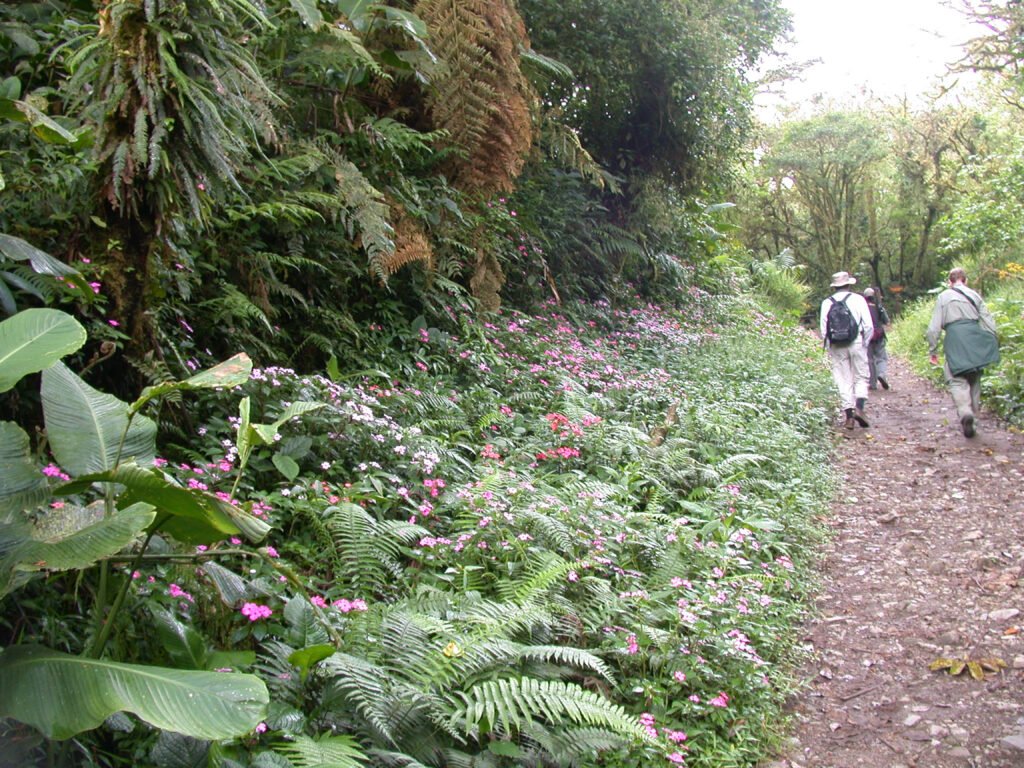
Illustrative photo: Monteverde cloud forest habitat by Ron Knight (sussexbirder), CC BY 2.0. Resized; thumbnails may be cropped. This image and its resized/cropped versions remain available under that license. It illustrates the setting or subject; it is not presented as an example of every technique discussed.