
Focus Stacking: Exploring Costa Rica’s Forest Details
Focus stacking can give a Costa Rica photographer another way to explore a still flower, a textured leaf or a quiet forest detail. The technique combines photographs focused at different distances into one image with a larger apparent zone of sharpness. Its appeal is creative control, not a requirement to make every nature photograph sharp from front to back.
Canon’s EOS R5 manual: Canon distinguishes automatic focus bracketing from the later combination of frames into a deeper-focus image.
Choose a subject that gives you time
A naturally still plant detail is a more practical starting point than a moving insect or bird. Wind, changing light and movement between frames can make a convincing blend difficult. Look for a permitted viewpoint where you can work without blocking the trail. Do not immobilize an animal or reposition vegetation simply because the technique needs stillness. A single frame remains a strong alternative.
Understand what the camera does
Focus bracketing records a sequence at different focus distances. Focus stacking merges that sequence, either in a supported camera mode or later in compatible software. Availability and restrictions depend on the camera, lens and settings; check your own manual. Practice at home so that an unfamiliar menu does not use up a valuable forest session. Carry only the support equipment you can manage comfortably and use it where permitted.
Keep the result honest and visually useful
After combining frames, inspect overlapping edges, fine hairs and areas that moved. More photographs do not automatically produce a better image. Compare the stack with your best single frame and choose the one that communicates the subject most clearly. Explain that an image is focus-stacked when relevant to its presentation or a competition’s rules. The technique can enrich a macro interest while birds remain a priority elsewhere in the journey.
Recommendations for your visit
- Begin with a still plant rather than an unpredictable animal.
- Check tripod permission and avoid obstructing narrow paths.
- Treat stacking as one creative option alongside selective focus.
Connect the subject with your route
Compare Monteverde, Sarapiquí. Check current access, services and conditions directly before finalizing plans.
Continue with Macro field techniques, Plants and insects.
Questions photographers ask
Are bracketing and stacking the same operation?
No. Bracketing captures the focus sequence; stacking combines it.
Does every camera combine frames automatically?
No. Some only capture the sequence, and compatibility varies. Check your model’s manual.
Can I stack a moving frog or hummingbird?
Movement makes blending unreliable and subject welfare takes priority. A single-frame approach is usually more appropriate.
Is maximum sharpness always better?
No. A softly rendered background or selective focus may communicate the subject more effectively.
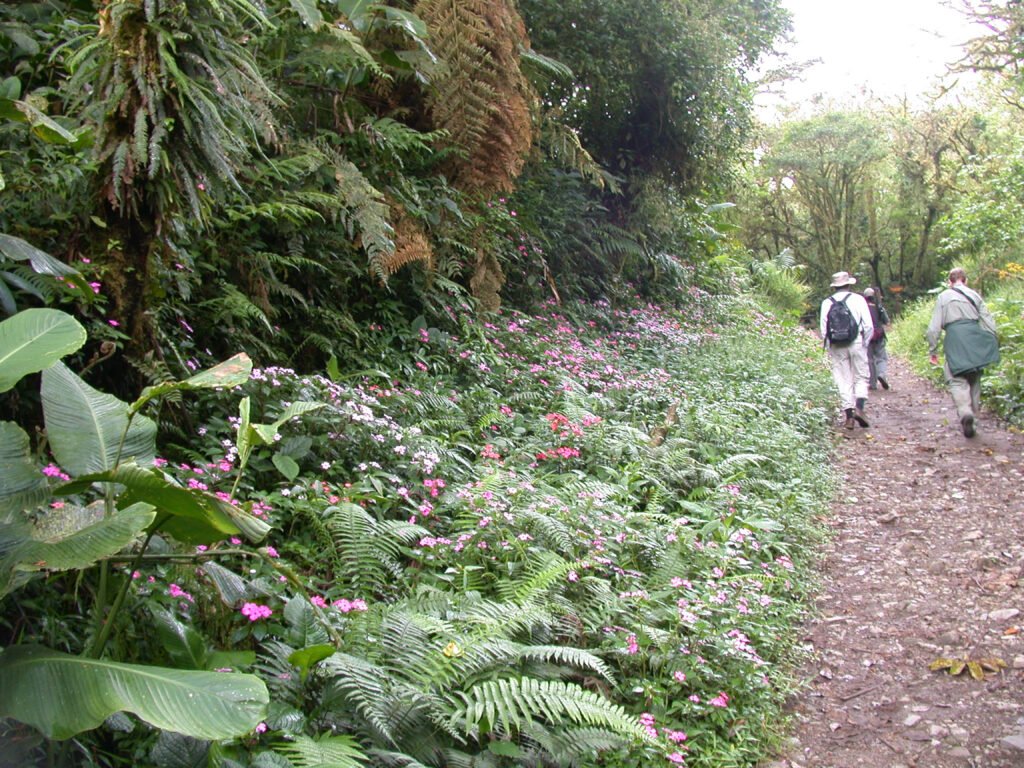
Illustrative photo: Monteverde cloud forest habitat by Ron Knight (sussexbirder), CC BY 2.0. Resized; thumbnails may be cropped. This image and its resized/cropped versions remain available under that license. It illustrates the setting or subject; it is not presented as an example of every technique discussed.